If you’re a new writer tiptoeing into the theatre world, you’ll hear the word R&D casually mentioned every now and then. It’s usually in the context of “Oh, I met so-and-so when we worked on an R&D together.” Or “I can’t make it next week, I’m R&D’ing on a new play.”
You’re nodding along politely, making a mental note to Google R&D on your phone, when you get a minute.
Fear not! I’m here to help and answer questions from a playwright’s perspective and chat about my own experiences in R&D’s and how they shaped my productions.
All my plays had the benefit of an R&D before full productions. Two have gone on to win awards (one of which, is now a multi-award winning short screenplay) and another one enjoyed a West End transfer to 5* reviews.
So what’s an R&D?
It stands for Research & Development, which in the theatre world means a week or a long day of creative exploration. This is a crucial step from penning the script, right through rehearsals, all the way to opening night.
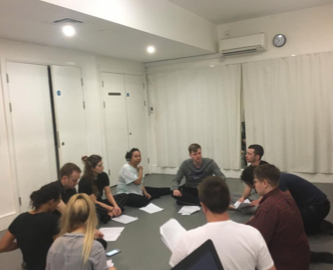
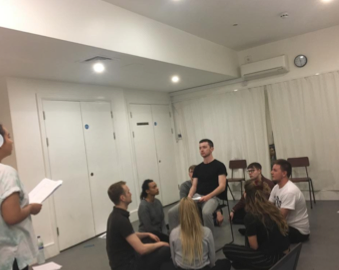
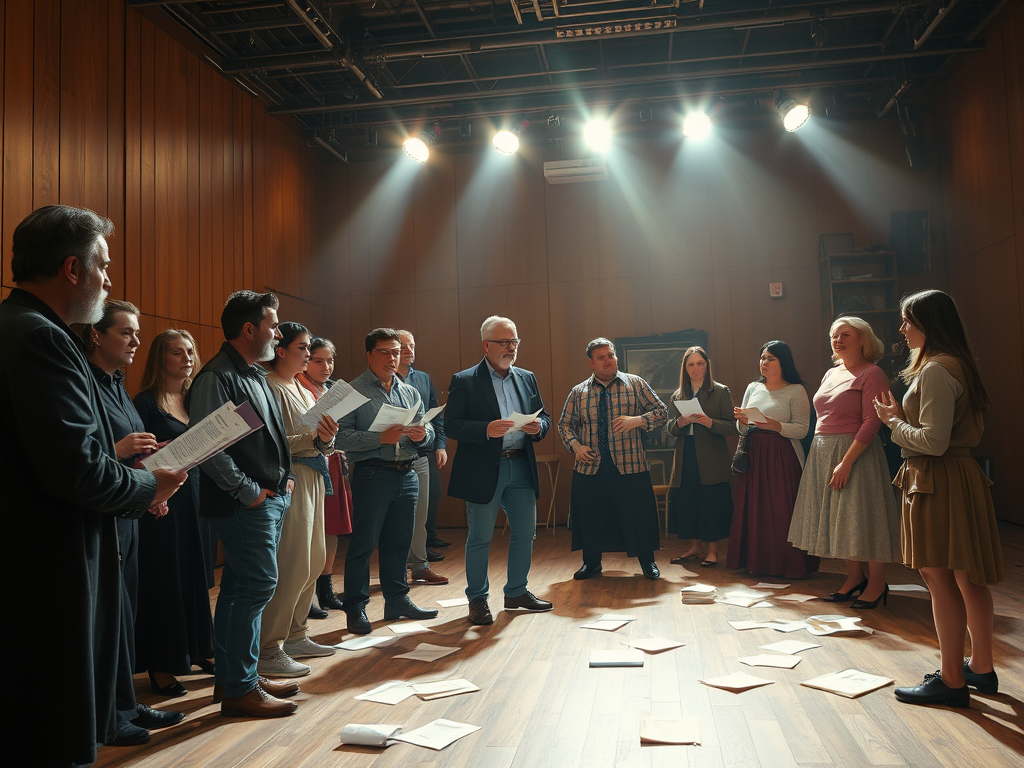
Usually it involves a bunch of actors, the writer, director and maybe the producer, depending on how involved they are. We get together and essentially workshop the script or an idea.
What happens during an R&D?
It depends on who’s running it. For me, it’s always been hosted by the director because they know how to handle actors and it’s naturally their process. But ultimately, it’s all for the benefit for the writer, so they can write the best script possible.
Usually we kick off by reading the play so we can hear it out loud for the first time with proper actors. Then we might chat about the text, characters, what works and what doesn’t feel right. There could be an exploration of political themes, history, religious context if any. It’s an exploration of the world your characters are living in.
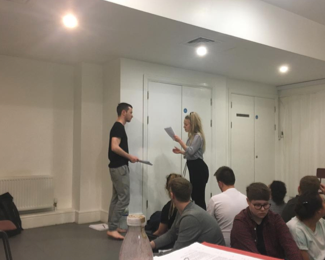
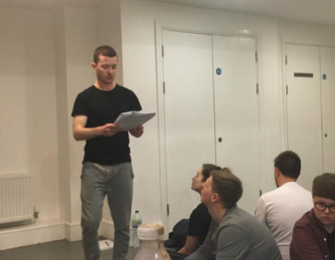
The director will have their own ideas in helping the script onto its’ feet. As a writer, your job is to watch, observe and make a lot of notes! Sometimes you’ll pick up on little gems like accents or phrases where you can say “I’ll have that!” and use it in your script.
With PlayFight, I was able to use the characterisations of the actors who actually lived in that world. It helped me create the language and London roadman vernacular which was needed for the characters.
What if i’m the writer & director?
If you’re the writer and director, then it’s basically your room. You’ll have the freedom to play and explore ideas from a text perspective, but also from a performance perspective. You’ll know what exercises you need to explore as a director and what you need to keep an eye on as a playwright.
what kind of exercises do you use for an r&d?
Anything exploring the main themes of the play. The director will usually take the lead on this, depending on how they work.
During an exploration of a theme of sexual harrassment in a PlayFight R&D, there was an exercise where the director had the actors get into each other’s personal spaces – but not physically touch each other. I just walked around with my notebook and observed their patterns, behaviours, even facial expressions.
do we need a full script to r&d or just an idea?
It depends what exactly you want to get from the process. With PlayFight we R&D’d five scenes, which I’d written by request of the Director. The producer had an idea and we decided to run with that, but first I had to write a skeletal copy of something. I had never worked like that before and it was definitely a learning curve – but a curve that led to success!
With Face to Face, we had an R&D back in 2019 where I had written an expanded version of the two-hander play, adding new characters, but I already had a script which we could work on. One of the actors who attended was a young man named Stephen Smith who brought such a different, vulnerable energy to the role of the antagonist, Scott. Since then, I was able to think of the character in a much different way. When I went back to writing his character for my short screenplay, I was able to use his performance from the R&D as a template. When it came to casting the role of Scott for my short film, the first person I thought to approach was Stephen.
Thankfully, he was really enthusiastic about getting on board and now he’s been cast in the movie!


WHAT IF I JUST HAVE AN IDEA?
If you have an idea for a story, then make sure you communicate exactly what your vision is, to the Director. Tell them what you want and don’t want for your play. This way, they can tailor their exercises toward your goal.
If you’re the Director, then you get to come up with the fun exercises! Let’s say, for example, you’re writing a play about a cowboy in space, but have no story, no plot, no characters, nothing! Start with delving into cowboy culture, then aerospace – and see what your actors can bring to the task. By the end, you should have a rough idea of a story and characters.
DO I NEED A TEST AUDIENCE?
You don’t need them, but an outside view definitely helps! Usually, a final part of the R&D process is a staged reading, in front of an audience. Test audiences are always invaluable when it comes to researching a play. They will give you the feedback you need to improve your work – and some of them pull no punches!
It’s always hard receiving criticism, but let it help fuel you. If the audience can’t understand your play, then talk to them, hold a Q&A after the reading, so you can ask ‘why?’ Listen to their concerns and see if you can apply it to your future drafts. You don’t have to agree or disagree, just listen!
For PlayFight, we had two staged readings and one of the audience’s main concerns was that they didn’t want their sons to think that death was an easy option. We agreed and I changed the ending of my play, which actually gave the character TJ a much bigger hero’s arc because of it. There was hope at the end of the play – otherwise, the original version, would’ve been very miserable indeed.
What kind of venue should i use?
Any space you can get your hands on. There are loads of theatre studio spaces in London and (I’m sure in other parts of the UK) that you can hire for an afternoon, for auditions, rehearsals and R&D’s. For The Beach House we used the Bedford Arms pub of the theatre!
Ideally, the space should have enough room – depending on your actors – to move around for warm ups and so the actors won’t feel so claustrophobic.
If cost really is an issue, you can always hold it in your living room and move some furniture around – just make sure it’s accessible for your actors.
You can also apply to the National Lottery Arts Council to fund an R&D or workshop.
CAN I FILM THE R&D?
You can, but please make sure to get the consent of everyone involved. Even if it’s for your own personal use, data protection is everything.
All photos used on my website have been given the thumbs up, by those involved. The video of the PlayFight R&D was from the Orisun Productions YouTube channel, which we all consented to.
You don’t have to get a signed contract or anything fancy, but make it clear what your intention is, with pictures, videos, etc.
IF I R&D’D AN IDEA, DO I NEED TO DO A SEPARATE ONE WITH THE FULL SCRIPT?
There are no limits to developing a play. Once I’d written the first script for PlayFight, we had about three read throughs and one more workshop, before we felt it was ready for an audience – and even then – it was a test audience.
This is also a decision that is made by the producer. If they want the show up and running straight away, but you’re not ready, you need to pitch an R&D session to them.
i’ve finished the r&d, now what?
If you don’t have a producer attached, you can pitch to companies with an R&D under your belt and if you have pictures and videos – even better! If you already have a company attached, then it’s up to them when you roll into production.
Good luck guys!
 Christina Alagaratnam